Showing posts with label Great Frigatebird. Show all posts

Sunday, 1 January 2017

Ashmore Reef 05 -- Middle Island and Horseshoe Cay

Middle Island and Horseshoe Cay

These were our destinations on third day at Ashmore Reef. This is the island where the terns usually live and breed. With 24,000 Sooty Terns and plenty of Bridled Terns on West Island, we wondered if there would be any left there!

The usual photogenic dawn.


As The Pig came into shore at Middle Island, Rohan Clarke yelled out, "Quick. Give me the binoculars". In the huge number of Sooty and Bridled Terns, Boobies and Lesser Frigatebirds spiralling in the updraft above the island, a "white tropicbird" was re-identified as a leucistic frigatebird, This was a mega find and many, many photos were taken. It was a star bird of the trip. We named him/her "Snowflake".

"Snowflake" Lesser Frigatebird Fregata ariel
Great Frigatebird, female Frigate minor
Lesser Frigatebird, male Fregata ariel
After the excitement of Snowflake and nesting frigate birds and boobies, we were off just a few hundred metres to Horseshoe Cay and it's plethora of shorebirds. Grey Plover, Pacific Golden Plover, Greater and Lesser Sand Plovers, Godwits, Turnstones, Stints, Sanderling, Tattlers, Terns, Greenshanks and one Terek Sandpiper.

 
One Terek Sandpiper Xenus cinereus amongst a scattering
of Sanderling Calidris alba with
a Grey-tailed Tattler Tringa breviceps,
a Lesser Sand Plover Charadrius mongolus and
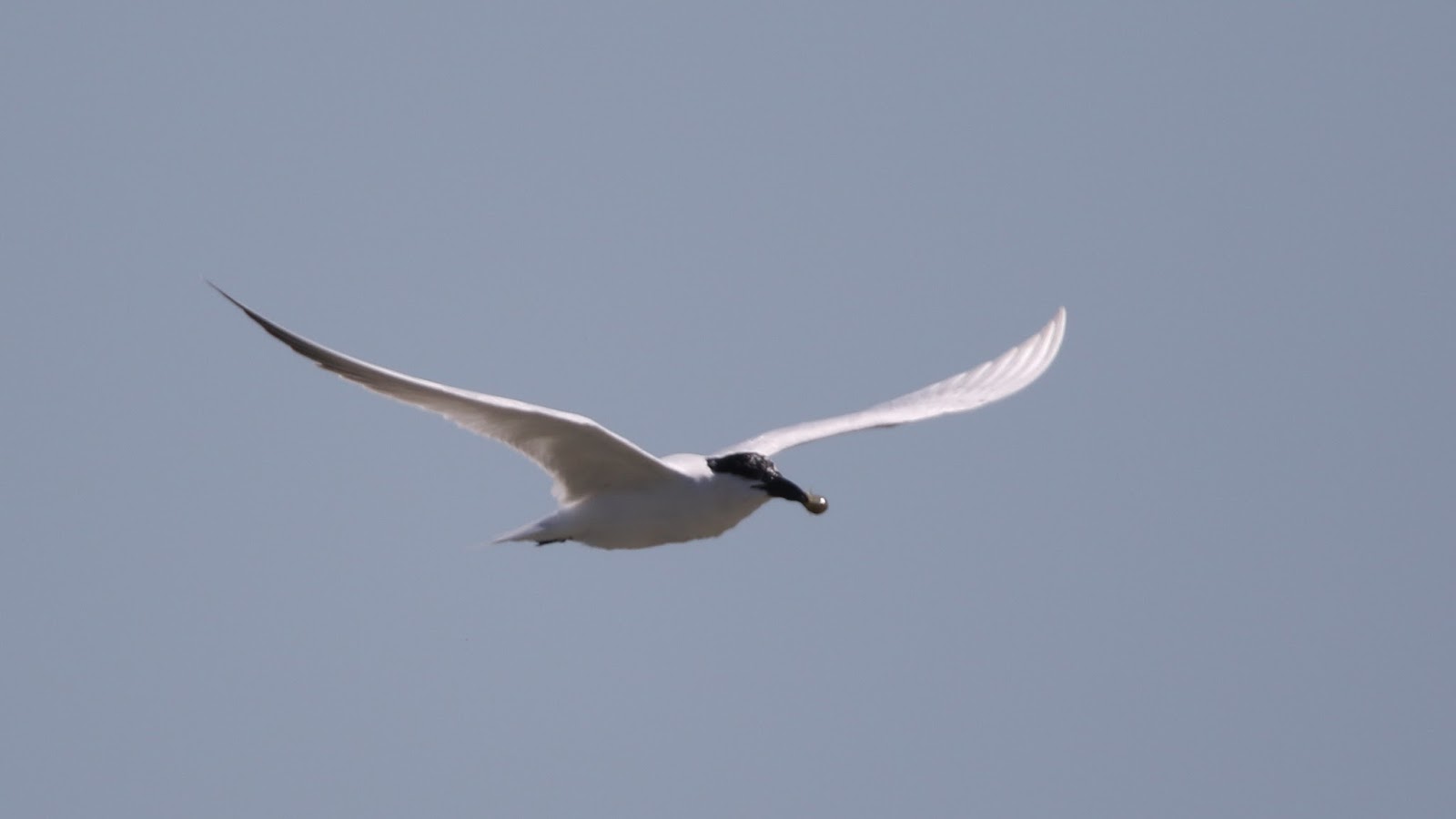
the asiatic race of the Gull-billed Tern Gelochelidon nilotica affinis
One interesting resident was this crab. Can you tell me what it is? I don't know! Reminds me of SquareBob Spongepants.


Wednesday, 28 December 2016

Ashmore Reef 03 -- West Island

The routine for each of the four mornings we were there was ...
  • Awake at 4.30 for light breakfast for a 5am visit to West Island
  • Two circuits of the island
  • An 8.30-9am return to the mother ship for a proper breakfast - continental on odd days and cooked on even days
  • After morning tea, we went to one of the other islands. East Island and Splittgerber Cay on the second day and Middle Island and Horshoe Cay on the third day. The fourth day was free time in the middle of the day and we left after breakfast on the fifth
  • On each day we revisited West Island again in the later afternoon for another two circuits. It was busy schedule.

West Island

This is the largest of the Ashmore Islands. Although oval-shaped, it is about 800 metres long and about 300 metres at the widest. There is one small patch and one larger patch of kikuyu-like grass, the centre of the island is a bare-ish patch and the rest is covered by low scrub to about a metre high. The western end has a "herb garden" of approx. 200 x 400 metres which, after a normal wet year, would be 6" tall. There is a ring of taller vegetation around the entire edge ranging from 3 - 8 metres tall. Some are big shrubs and some are almost like tangled trees. Ashmore Reef has been in a drought for over three years hence most of the ring of shrubs/trees was looking pretty sick with few brown leaves [dead?]. This made finding the passerines easy as. The second last palm tree had died and most of the vegetation was looking pretty ordinary. Where there had been fields of herbs and plants, there was nothing, just some dried out stems. And fire-ants were present. An eradication program had been underfunded and the ants not eliminated. We found some. One Red-tailed Tropicbird on a nest was being harassed by the ants. You could see the effect on her/him with continual blinking and head shaking.

One feature of West Island this year was the presence of Sooty, Bridled and Crested Terns plus the multitudes of Noddys. Rohan Clarke and Mike Carter have been to Ashmore many times. Rohan estimated he had been on West Island more than one hundred times! In all of those visits, not one tern had ever been seen on West Island so the entire birdscape and noise level was different to any visit previously.

Each morning's walk started from the eastern end of the island.
Here is the dead palm tree.
Part way along the northern edge is the hand pump. It works fine.
Water tastes good.
The map at the bottom shows Joe Public where he can go without a permit!
Here is the kikuyu-like grass patch. Each day we beat our way through it
to flush any small passerine that could be hiding in there. No such luck. 
The smaller patch.
It is hard to see the size but this is an example of the 3-8 metre high
scrub around the edge. I think there may be a bird in there!
More edge vegetation. Not many leaves.
New birds for me were ...
Eastern Yellow Wagtail
Island Monarch
Sooty Tern
Rose-crowned Fruit-dove
Edible-nest Swiflet
Arafura Fantail
Eastern Yellow Wagtail Motacilla tschutschensis
Island Monarch Monarcha cinerescens
"Swarm" of Sooty Terns Onchyoprion fuscata
Rose-crowned Fruit-dove
Ptilinopus regina xanthogaster
This is one of the 'Grey-capped' group of
Rose-crowned Fruit-doves!!
Edible-nest Swiflet Aerodramus fuciphagus
Arafura Fantail Rhipidura dryas
Other birds included ...
Buff-banded Rail
Great Frigatebird
Crested Tern
Oriental Plover
Sharp-tailed Sandpiper
Black Bittern
Rainbow Bee-eater
Horsefield's Bronze-cuckoo


Great Frigatebird Frigate minor amongst a swarm of Sooty Terns Onychoprion fuscata
Crested Tern Thalasseus bergii
Buff-banded Rail Gallirallus philipensis
Nesting.
Oriental Plover  Charadrius veredus
Sharp-tailed Sandpiper Calidris acuminata
Black Bittern Ixobrychus flavicollis
Rainbow Bee-eater Merops ornatus
Horsefield's Bronze-cuckoo Chalcites basalis


Saturday, 15 October 2016

Go North 02 -- Weipa

Ethan and I caught up with the others just as we got to Weipa to hear the news that the 60-series had a touch of overheating! A job for the next day. One workshop had a three day waiting list just to be seen so we checked out another who dealt with the problem. However, the following day the problem recurred and it became a radiator and water pump transplant requiring the vehicle's presence in Weipa for a week whilst parts were sourced from Cairns.

Thus, while that was being sorted, Ethan and I were able to bird a bit of Weipa. We stayed in the caravan park [there is only one] which was pretty good. It has a westerly-facing beach which had plenty of activity and was close to various lakes around town.

Green Pygmy-Goose Nettapus pulchellus
Black-necked Stork Ephipiorhynchus asiaticus
Black Kite Milvus migrants trying to outpace a jet!
Osprey Pandion haliaetus
 Almost the entire time we were walking in the shallows and mud of low tide, a pair of Ospreys were hunting and diving into the water, sometimes quite close, say 50 metres. We saw two fish captured.
Three Red-necked Stints Calidris ruficollis on the left
and one Red-capped Plover Charadrius ruficapillus
Lesser Crested Tern Sterna bengalensis with the orange beaks
Crested Tern Sterna berg with the yellow beaks
Whiskered Tern Chlidonias hybridus in the foreground
Darter, female Anhingas melanogaster to the right
Terns in the background
Whiskered Tern  
Gull-billed Tern Sterna nilotica with snack
Little Egret Ardea garzetta
Finally, the stars of the day. Weipa beach is renowned for the presence in the evening of significant numbers of Frigatebirds, both Great and Lesser, "surfing" the on-shore breeze as they gather to communally roost. It is a pretty impressive sight to see about eighty of these birds wheeling across the sky without one wingbeat by any of them.
Great Frigatebird, male Fregata minor
Great Frigatebird, female
Lesser Frigatebird, female
Lesser Frigatebird, male Fregata ariel
Magic. t1,250 and be there.