Showing posts with label Lesser Crested Tern. Show all posts

Wednesday, 20 September 2017

Broome 2017 _ Wave The Waders Goodbye _ Day 07

Day 07


My flight back to Melbourne via Perth left at 6pm so I had the day around the BBO ...

... to lounge in the newly constructed Kitchen, walk a track or two and then do some serious wader watching on an incoming tide. My only bird image of the morning walk was a White-throated Gerygone.

White-throated Gerygone Gerygone olivacea


The plan for the wader watching was simple. Take a low chair, sit a hundred metres out from shore, in the mud, and wait for the tide to “drive” the waders towards me. Nigel Jackett, BBO Warden, has some fabulous images of birds obtained with a similar but way more serious technique of lying on a boogie board in the mud. Being at eye-level with the birds is best but I didn’t have a wetsuit so decided a low chair was the nearest I wanted to manage. Here are the results in Christian Name alphabetical order.

Bar-tailed Godwit Limosa lapponica

This Barwit has GGT and GrK friends with him.

Great Knot Calidris tenuirostris

Grey-tailed Tattler Tringa brevipes

Lesser Crested Tern Sterna Thalasseus bengalensis

Little Tern Sternula albifrons 


Marsh Sandpiper Tringa stagnatilis
 

Ruddy Turnstone Arenaria interpres

Terek Sandpiper Xenus cinereus

Whiskered Tern Chlidonias hybrida Non-breeding adult.

So now that you have seen heaps of waders, here are two wide-angle shots. See if you can identify the birds. My answers in the next post.


Friday, 8 September 2017

Broome 2017 _ Wave The Waders Goodbye _ Day 02

Chris Hassell works for the Global Flyway Network. He bands birds during our summer, records the birds that are present at Broome then spends weeks in China looking for banded birds on their way to their breeding grounds. This is to monitor world populations of migratory shorebirds. Each bird is given two coloured flags on each leg plus a flag which has 6 positions it can be in [top, middle, bottom on each leg]. Thus birds are individually marked. Below are some examples. But first you have to find the birds in this lot!


And then something like a Peregrine Falcon or Whistling Kite or Brahminy Kite or Brown Goshawk spook them and they ALL take off. Back to square 1.

Day 02

Bar-tailed Godwit Limosa lapponica 
1BLLR [flag in position 1 on top on left leg; blue, light green, light green, red]

Great Knot Calidris tenuirostris
1BRRR. Images don't have to be in focus to ID the birds!

Bar-tailed Godwit Limosa lapponica
1RYYB

Great Knot Calidris tenuirostris
5BBYL
Sooty Oystercatcher Haematopus fuliginosus
Yellow W5

Great Knot Calidris tenuirostris
?YLYR

Also in this shot are:
Little Tern Sternula albifrons
Red Knot Calidris canutus
Lesser Crested Tern Thalasseus bengalensis
Greater Sand Plover Charadrius leschenaultii


Monday, 4 September 2017

Broome 2017 _ Wave The Waders Goodbye _ Day 01

Well, not permanently. Until next spring. Broome Bird Observatory does a 5-day course in late March/early April when waders gather in Roebuck Bay and set off to their northern hemisphere breeding destinations.

You live on base. The cuisine is themed for the seven world-wide migratory flyways. You do a tour each day, have some lectures/talks and spend the last few hours of each day observing gathering birds on the bay and watching them head off. Usually. Bar-Tailed Godwits and Great Knots are migratory. The others are Aussie residents.

Day 01

Bar-tailed Godwit Limosa lapponica


Great Knot Calidris tenuirostris


Brahminy Kite Haliastur indus


Eastern Reef Egret Egretta sacra grey morph


Lesser Crested Tern Thalasseus bengalensis


Nankeen Night Heron Nycticorax caledonians juvenile


Saturday, 15 October 2016

Go North 02 -- Weipa

Ethan and I caught up with the others just as we got to Weipa to hear the news that the 60-series had a touch of overheating! A job for the next day. One workshop had a three day waiting list just to be seen so we checked out another who dealt with the problem. However, the following day the problem recurred and it became a radiator and water pump transplant requiring the vehicle's presence in Weipa for a week whilst parts were sourced from Cairns.

Thus, while that was being sorted, Ethan and I were able to bird a bit of Weipa. We stayed in the caravan park [there is only one] which was pretty good. It has a westerly-facing beach which had plenty of activity and was close to various lakes around town.

Green Pygmy-Goose Nettapus pulchellus
Black-necked Stork Ephipiorhynchus asiaticus
Black Kite Milvus migrants trying to outpace a jet!
Osprey Pandion haliaetus
 Almost the entire time we were walking in the shallows and mud of low tide, a pair of Ospreys were hunting and diving into the water, sometimes quite close, say 50 metres. We saw two fish captured.
Three Red-necked Stints Calidris ruficollis on the left
and one Red-capped Plover Charadrius ruficapillus
Lesser Crested Tern Sterna bengalensis with the orange beaks
Crested Tern Sterna berg with the yellow beaks
Whiskered Tern Chlidonias hybridus in the foreground
Darter, female Anhingas melanogaster to the right
Terns in the background
Whiskered Tern  
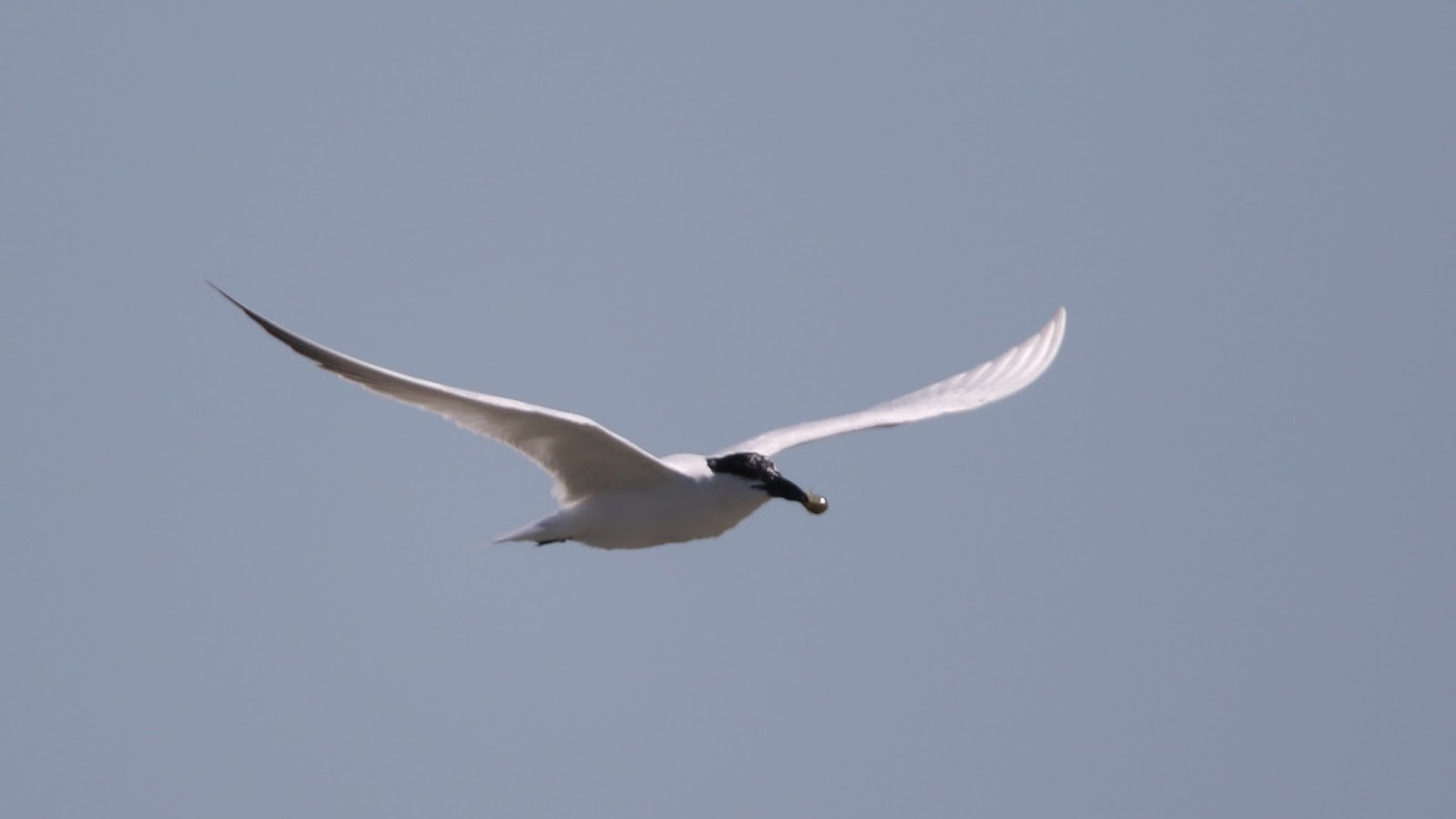
Gull-billed Tern Sterna nilotica with snack
Little Egret Ardea garzetta
Finally, the stars of the day. Weipa beach is renowned for the presence in the evening of significant numbers of Frigatebirds, both Great and Lesser, "surfing" the on-shore breeze as they gather to communally roost. It is a pretty impressive sight to see about eighty of these birds wheeling across the sky without one wingbeat by any of them.
Great Frigatebird, male Fregata minor
Great Frigatebird, female
Lesser Frigatebird, female
Lesser Frigatebird, male Fregata ariel
Magic. t1,250 and be there.