Six folks interested in birds met in Moe and visited two locations, both within the town boundary.
The first was Ollerton Avenue Reserve. This was a pleasant stroll along paths with our total bird list of 16 over 40 minutes.
The undoubted highlight was getting views of an Eastern Whipbird. They are easily recognisable from their call, of course, a "ringing whipcrack"
Simpson & Day and suddenly we spotted it diving across a path into a bush on a corner, crest erect with its bold white cheek stripes. We quietly approached as the scrub [eucs, manuka] was a tiny bit isolated on the corner and we didn't see it fly out of the other side into the contiguous vegetation. Sure enough, there it was in the manuka, just quietly doing its foraging business. I snuck up on the bush side of the manuka but was too close to take a photo!! However the bins focus down to one metre so great views were obtained. The others were all on the path on the other side of the bird and images were snapped. This was only the second time in my life I have seen a whipbird so I was dead chuffed. Perhaps the site frequented by lots of people and their dogs has made this particular individual just a bit human-habituated.
We then headed to the Edward Hunter Heritage Bush Reserve on the Coalville Road.
After filling the carpark with our six cars, we had morning tea then decided on a plan of action. Essentially we went down to the lake then did a wide clockwise circuit to the south bringing us back to the carpark for lunch. Here is what we expected to see.
It is a very pleasant spot for either a walk or a bird safari with plenty of flora [orchids] to keep all happy. We passed families with young kids, bike riders, runners and other walkers.
 |
| Heyfield Birdwatchers closely studying something. |
At one point we were stationary for quite a few minutes as Bev gathered life ticks in one rowdy, clamorous area with fan-tailed cuckoos, golden whistlers, large-billed scrubwrens, white-browed scrubwrens, thornbills plus background musical accompaniment from crimsons rosellas, whipbirds, grey fantails, pardalotes, currawongs etc. It was a great birdwatching smorgasbord. Of the 58 species on the board, we saw 28. Additionally we saw 10 not on the board. Wood Duck, Purple Swamphen, Dusky Moorhen, Little Black Cormorant, Eurasian Coot, Rainbow Lorikeet, Eastern Whipbird [voice!! hard to get lucky twice in one day], Mistletoe Bird and two extra specials -- Large-billed Scrubwren and Brown Gerygone.
The Brown Gerygone [no image, sorry] has a range variously cited as "down to the NSW border"
Simpson & Day, "north from eastern Victoria"
Slater, "south to Morwell"
Slater and similar in the Morcombe app. Members of the party who had seen the bird before were able to positively identify it and have experience of it being sighted further to both the south and west of Moe. What a day.
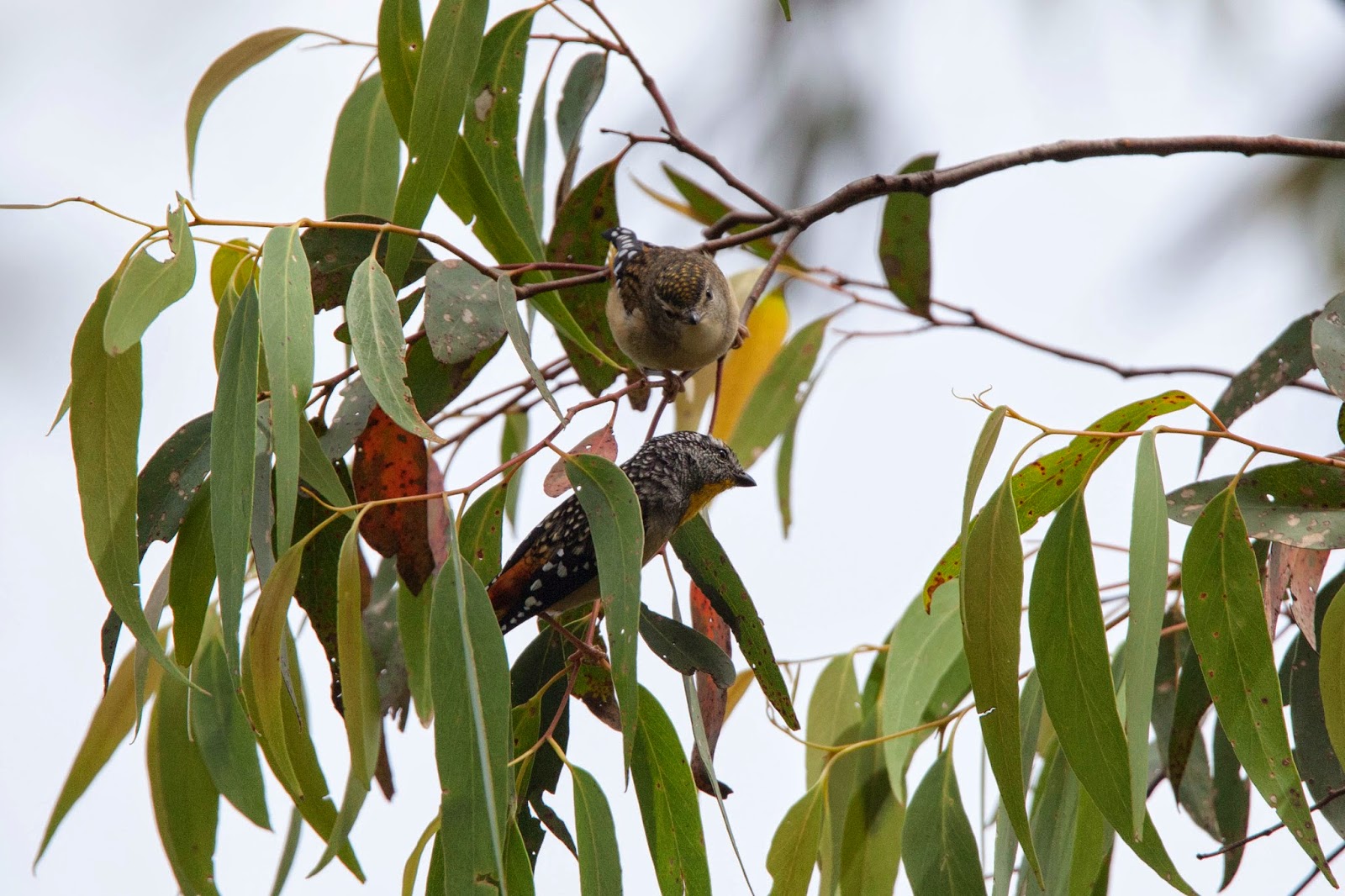
Here are just a few images I took.
 |
Spotted Pardalote
Pardalotus punctatus xanthopyge |
 |
| Adult Spotted Pardalote below, offspring above |
 |
Olive-backed Oriole
Oriolus sagittatus |
 |
Red-browed Finch
Neochmia temporalis |
 |
Fan-tailed Cuckoo
Cacomantis flabelliformis |
 |
Golden Whistler
Pachycephala pectoralis |
Magic. f8 and be there.