Today three members of the Heyfield Bird Watchers fled west to meet Gouldiae at Drouin and then spend the dull, dismal but ultimately rain-free day birding three sites around Nyora. Marg, Jim and Jack travelled in Gouldiae's vehicular transport with the first stop being Lang Lang Reserve just a few kilometres out from the town on the Drouin Road. A new path had been constructed and we saw 24 species here. It was the site of an old primary school. Only the shelter shed remained. After stocking up Jim's larder in Lang Lang we moved on to Wuchatsch Reserve near Nyora where we walked a couple of kilometres of bush track with Brown Gerygone, Brown Goshawk, Varied Sitella and a mob of Silvereyes being seen amongst the 23 species there. Gouldiae blogged here.
Onwards to lunch in Nyora in the park by the railway station and a careful perusal of the 50 or so Rainbow Lorikeets and Red and Little Wattlebirds in three profusely flowering eucs revealed ... no Swift Parrots.
Our last port of call was the Henry Littledyke Reserve on the Nyora-Poowong Road. It contains the old railway reservoir that supplied water, powered by gravity, to steam engines at Nyora Station. Here we spotted a pair of Wedge-tailed Eagles, a Brown Goshawk, Crimson Rosellas, Superb Fairy-wrens, White-naped Honeyeaters, Golden Whistlers, Eastern Yellow Robins, Eastern Spinebills and a lone male White-throated Treecreeper. The day was so uninspiring photographically that the only images I took were of a whirly-gig insect making a delightful pattern in the reservoir and the aforesaid WTTc.
That said we had a great day visiting some lesser unknown parts of Victoria, spotting all-in 40 species of bird and having a good laugh too. Thanks Pete.
Thursday, 21 April 2016
Friday, 11 March 2016
Wandering Dutchman gets SE-wing
Our failure to see a live Ground Parrot prompted us to drive out to Shipwreck Creek early the following morning to another "Where to see ..." recommendation with the added chance of seeing Southern Emu-wren and Striated Heathwren.
The walking track heads west from Shipwreck Creek towards Seal Creek.
After traversing Shipwreck Creek and crossing the beach you quickly climb into a heathland that Robert described as "perfect". Time for the birds.
Although we didn't hear or see a Ground Parrot, we saw lots of other birds in the gorgeous early morning light during our walk of about 3 km return. An "accidental" life-tick was the Beautiful Firetail below identified only after we scrutinised the images of a bird we knew was a finch but couldn't discern properly because it was a silhouette almost directly into the rising sun. It has to be said that these days there are some fantastic aids to our birdwatching. Digital cameras and computer software.
Another great bird was a Varied Sitella gathering insects on the bark of a tree on the edge of the heath.
We had seen on Birdline that a Striated Heathwren was in the vicinity so sparked up the playback mode for two, yes, just two, calls and in he came.
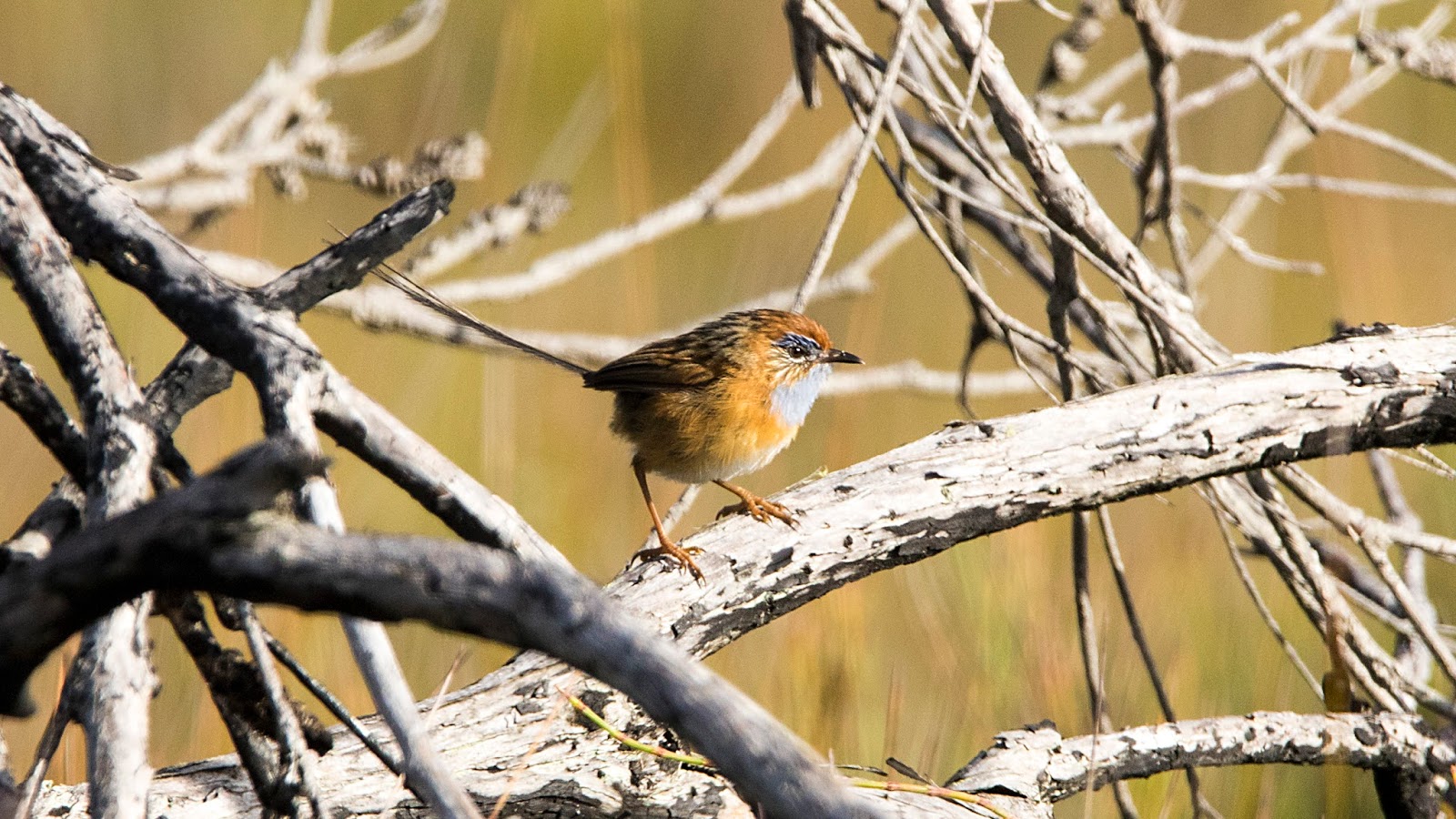
But the main excitement at this site was caused by the Southern Emu-wren of which there were a plethora. We saw 20 or so birds in several, probably four, families on the approximately 19 hectares of heathland. No apologies for the following plethora of images of this lovely little bird. The only thing missing is an image of a male with his tail straight up in the air.
The walking track heads west from Shipwreck Creek towards Seal Creek.
| Image by Robert Middelveld |
| Image by Robert Middelveld |
![]() |
| Beautiful Firetail |
![]() |
| Varied Sitella |
We had seen on Birdline that a Striated Heathwren was in the vicinity so sparked up the playback mode for two, yes, just two, calls and in he came.
![]() |
| "Just who is in MY territory? I'd better out-sing him" |
Wednesday, 9 March 2016
Wandering Dutchman meets CSI: Mallacoota
WARNING: This post contains images that may shock you. A bit. Maybe. Probably not. Read on.
After the wonder of the Wandering Tattler, we wondered what to do next. Mallacoota here we come. Towards evening we went on a search for the Ground Parrot. According to the book by Dolby and Clarke: Where To Find Birds in Australia, a favoured spot is the heathland surrounding the aerodrome at Mallacoota. Normally you would consider heathland to consist of lots of variation in height [say up to a metre] of lots of different species, perhaps the occasional small tree. Here, surrounding the aerodrome, security and fire risks are mitigated by slashing.
In the picture above you can see that the vegetation height of the heath is very low, hardly high enough for a budgie to hide in let alone a Ground Parrot. But this was a noted place to see the bird so we slowly zig-zagged across the heath and then around the edges hoping to flush one/some. And then we found one. Just one. About three metres from the double strand plain wire fence separating the gun club from the heathland. And slightly the worse for wear. Well, dead actually.
Yes, he was dead. The ants were already investigating the carcase. But what an opportunity to examine, in the hand, a rarely seen bird.
And then, the veterinary pathologist part of me started thinking. Hmm. How often do you see a dead bird? Not that often. And here is a species that is shy and elusive, uncommon to rare. And we find a body. Better examine it a bit more closely. The next image shows the examination environment.
The next image shows the beautiful markings on the belly.
After the wonder of the Wandering Tattler, we wondered what to do next. Mallacoota here we come. Towards evening we went on a search for the Ground Parrot. According to the book by Dolby and Clarke: Where To Find Birds in Australia, a favoured spot is the heathland surrounding the aerodrome at Mallacoota. Normally you would consider heathland to consist of lots of variation in height [say up to a metre] of lots of different species, perhaps the occasional small tree. Here, surrounding the aerodrome, security and fire risks are mitigated by slashing.
| Example of the heathland around Mallacoota aerodrome. Good for roos. |
And then, the veterinary pathologist part of me started thinking. Hmm. How often do you see a dead bird? Not that often. And here is a species that is shy and elusive, uncommon to rare. And we find a body. Better examine it a bit more closely. The next image shows the examination environment.
The next image shows the beautiful markings on the belly.
So a look-see [not a pathology term!] underneath showed that the right humerus [top wing bone] was broken.
Hmm. No blood either. Thus no haemorrhaging which you would expect from a broken bone. Must have broken the humerus on or after death. Perhaps the point of death. Continues examination. The head showed traumatic injuries.
There was a scrape, almost like beak had been rasped off, on the right side of the base of the beak and an indentation and missing feathers on the right side of the top of the cranium. Suddenly it all made sense.
My hypothesis is that this bird, probably with mates, was flying along at parrot speed [pretty fast] when he hit one of the two single strands of plain wire [about 8 gauge -- real thick] of the fence. First with the base of the beak then the head -- instant death -- then his humerus which breaks [and doesn't bleed because his heart has stopped beating] and momentum takes him cartwheeling several metres away from the fence, stone dead. One of the hazards of life. CSI, Silent Witness, eat your heart out!!
Pretty sad really but what an opportunity to examine such a bird. Wow. We didn't see any that evening nor the next morning when we walked the heathland at Shipwreck Creek but we did hear lots in heathland at Greencape Lighthouse in the Ben Boyd National Park in NSW towards Eden.
Subscribe to:
Posts (Atom)