Monday, 7 March 2016

Wandering Dutchman meets Wandering Tattler

After breakfast it was on to the main business of the day. A Wandering Tattler had been reported on Victoria Birdline by Tim Dolby on 22 January at Clinton Rocks near Tamboon Inlet near Cann River.

The bird to differentiate a WT from is a Grey-tailed Tattler, a bird I have seen this season at Lake Tyers Beach and a relatively regular visitor to Victoria over summer, especially Corner Inlet and Westernport Bay Pizzey & Knight. WT have never been reported here before in Victoria although it is a uncommon but regular visitor north of, perhaps, Sydney Morcombe. Visually, the WT has darker grey plumage than GTT and smaller white eyebrows that do not meet on the forehead and rarely extend beyond the eye Pizzey & Knight. Otherwise they both are about 26-7 cm, elegant, evenly grey-shaded, whitish below. My first question is "What was Tim Dolby doing at Clinton Rocks?" It is a small surf beach with rocky points at both ends at the end of a steep climb down from the end of a dead end track. My second question is "How did he see the bird and recognise it as unusual?" I have nothing but admiration for his birding abilities. What a find.

The Victorian Birders FB page had several posts from people who had been to twitch the bird since Tim first found it, the latest being 29 January. Expedition Tattler occurred 30 January. I had high hopes.

Clinton Rocks are just a few kilometres along the coast from Tamboon Inlet and accessible by a relatively easy gravel/sand track from the Tamboon Inlet Road. Simpson and Day say that WT habitat is reefs and rocks. Pizza & Knight notes quite specific habitat of "coral islands, cays of Gt Barrier Reef; rocky reefs, islands, wave-washed rocks and rock platforms". Tim commented in a Facebook post that, in his experience, WT "often hang around the same group of rocks for some time". It all sounded very promising.

Down to the beach the three of us went. Two sets of bins, two cameras, two scopes. This bird had no chance. We had to brush aside the Hooded Plovers, of less interest on this occasion.

Hooded Plovers. They had been seen mating the previous day.
Perhaps a new generation to come.
When we came out onto a lovely surf-washed beach we could see Clinton Rocks off to the west, only a few hundred metres or so. We approached the rocks and quietly had a good look all over. But no bird to be seen. Robert and Heath hopped onto the top and had a look further westward.


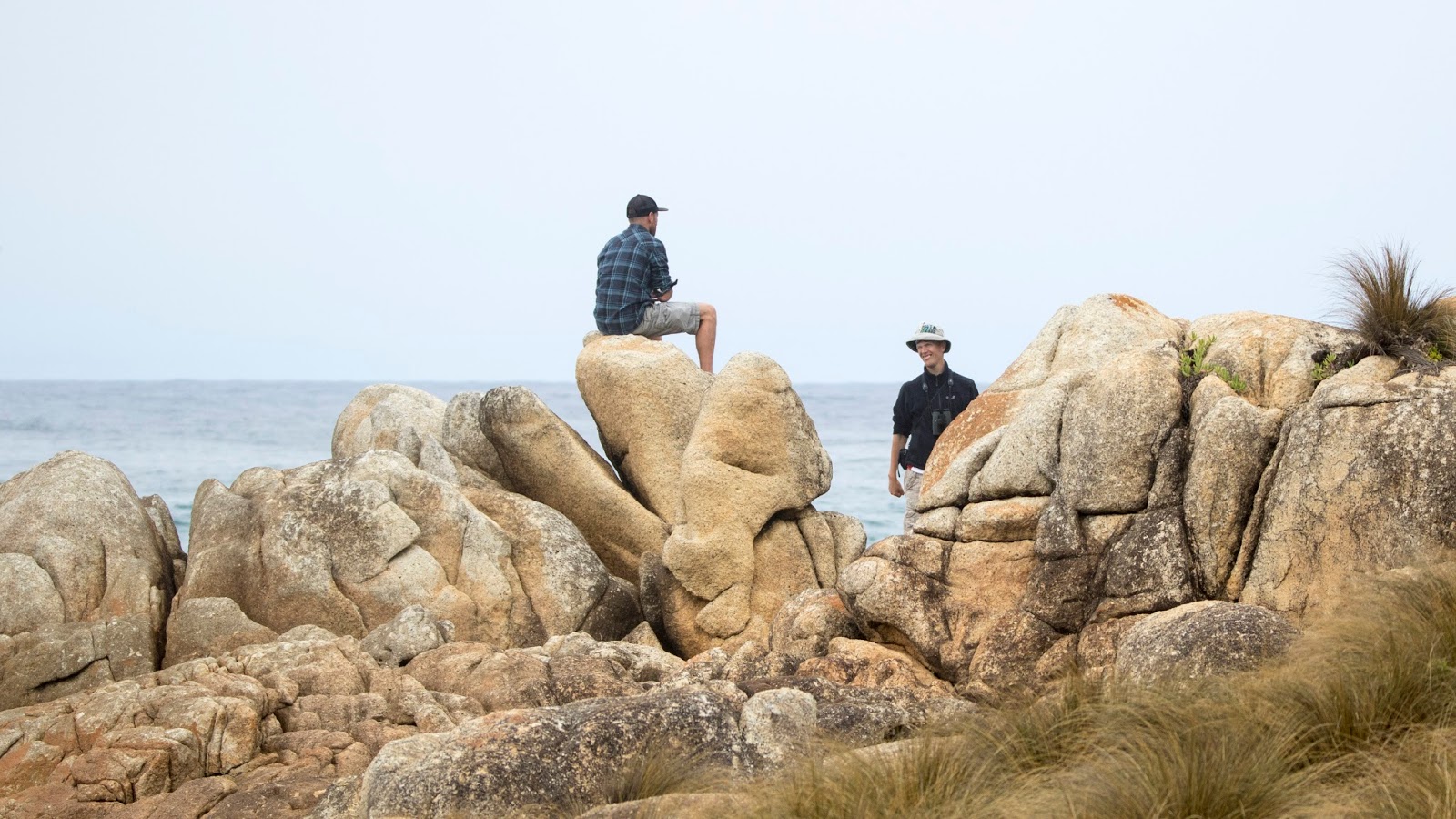
Within 90 seconds Robert had spotted it, about 200 metres away on the rocks that extended along the coast to the west of where they were standing. It was a pretty spectacular find. Here is the view that he had.


I was still pretty impressed when he told me that he had seen it silhouetted against the white water of a breaking wave.


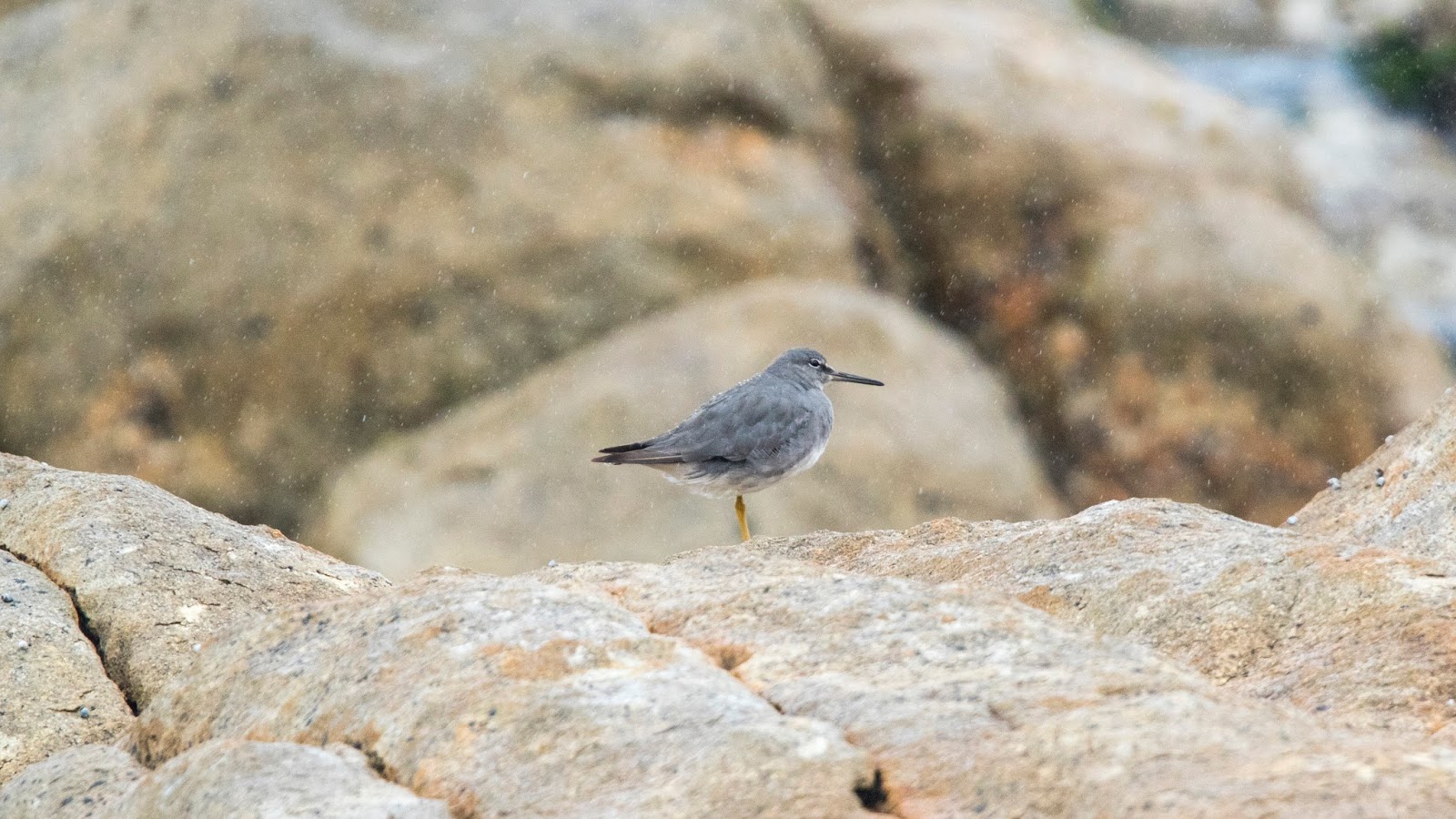
Ah yes. Easy now!! So we got the gear and carefully worked our way towards the bird. I have quite a few images taken as we were getting closer. Morcombe says "tends to be alert and wary" so we expected it to scoot off at any time. Eventually we managed to get within 10 metres or so of the bird without it even putting its leg down. Had a very good look through the bins, took photos and quietly and carefully retraced our steps. By the time we had reached the sand again, it had still not moved a muscle!

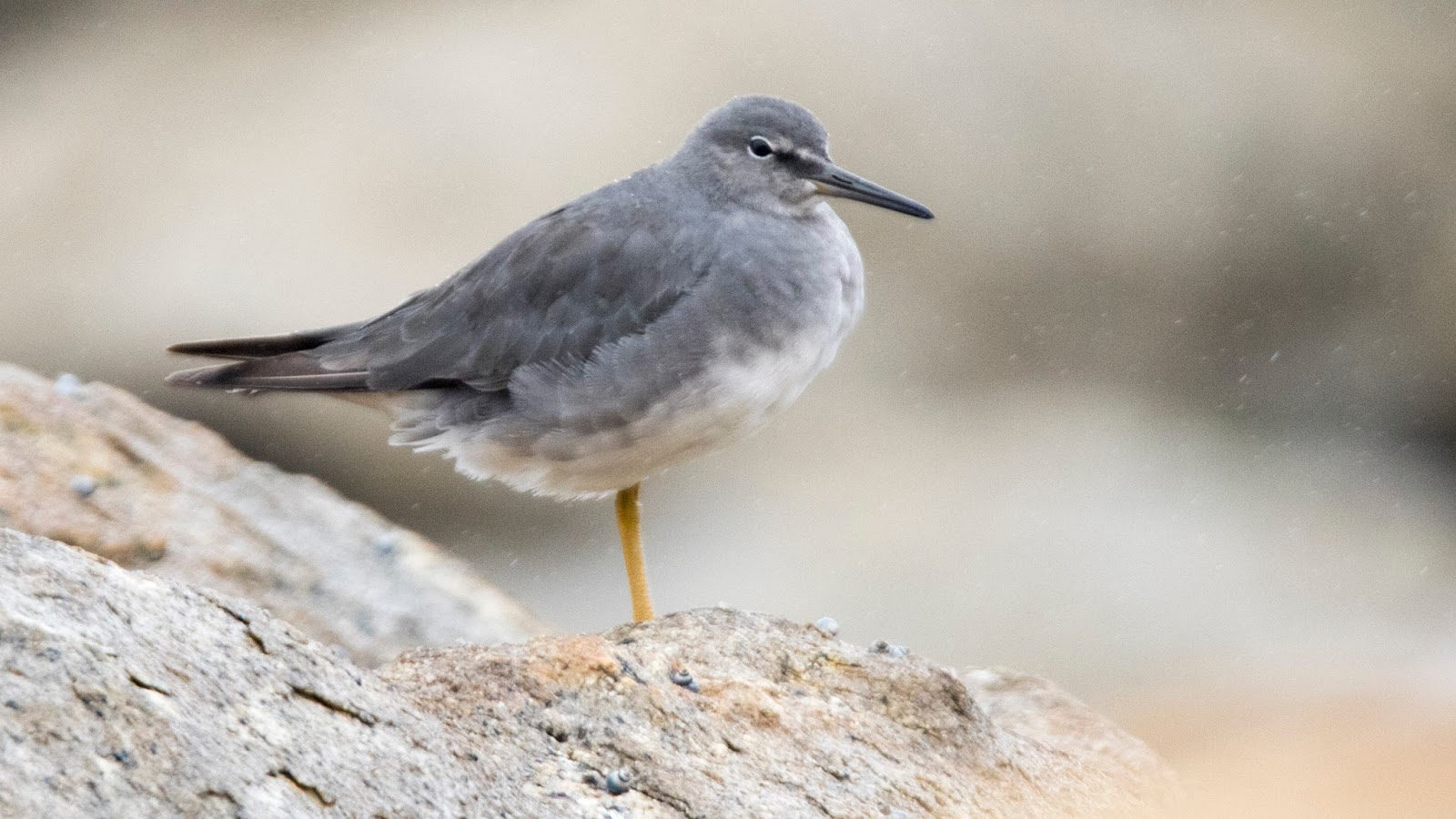

Sharpened image.
Graeme Bailey from Traralgon is a bit of a Photoshop Whiz and he did various things to the image above the most obvious being increasing the sharpness. Thanks Graeme.

Here is my image of a Grey-tailed Tattler from Lake Tyers Beach back in December.


Well, mission accomplished and Robert saw a piece of Australian coastline that not many Australians get to see. It was a privilege to view this bird. Magic. f8 and be there!

Saturday, 5 March 2016

Wandering Dutchman wanders to East Gippsland

Then it was time for the trip to commence. Heath used his mum's car for a bit whilst Robert and I followed in the supply truck, my 70 series Landcruiser, packed to the gunnels with stuff. Robert was keen to see Lakes Entrance so we detoured there and parked up at the parking area on Bullock Island looking towards The Entrance. It was raining a bit, too much to have any enthusiasm for getting out of the car. We spotted a pod of dolphins slowly coming towards us through the entrance from the ocean and a small group of Australian Furseals [residents] also playing around. There were many Great Cormorants and Australian Pelicans sitting/sleeping/resting/preening on the woodwork of the entrance by Cunningham Arm. Suddenly they all took off and a feeding frenzy started right in front of us. It seemed the dolphins had been following food/fish coming in from the ocean driving the food source in front of them. Well, everybody got in the action. The pelicans mainly trying to "strong-arm" caught fish from the cormorants and the cormorants dive-bombing the food with dolphins and seals in the midst of it all. This went on for about 10 minutes gradually coming further into Lake King. The images were taken through the windscreen; not brilliant but give you a feel for the action.

Dolphin and seals
General Mayhem with dolphin to the left
We then left for further east and camped at Tamboon Inlet. The next morning there were plenty of birds around the camp.

Eastern Yellow Robin
This could be a male Satin Flycatcher although the accompanying female look like a Leaden Flycatcher
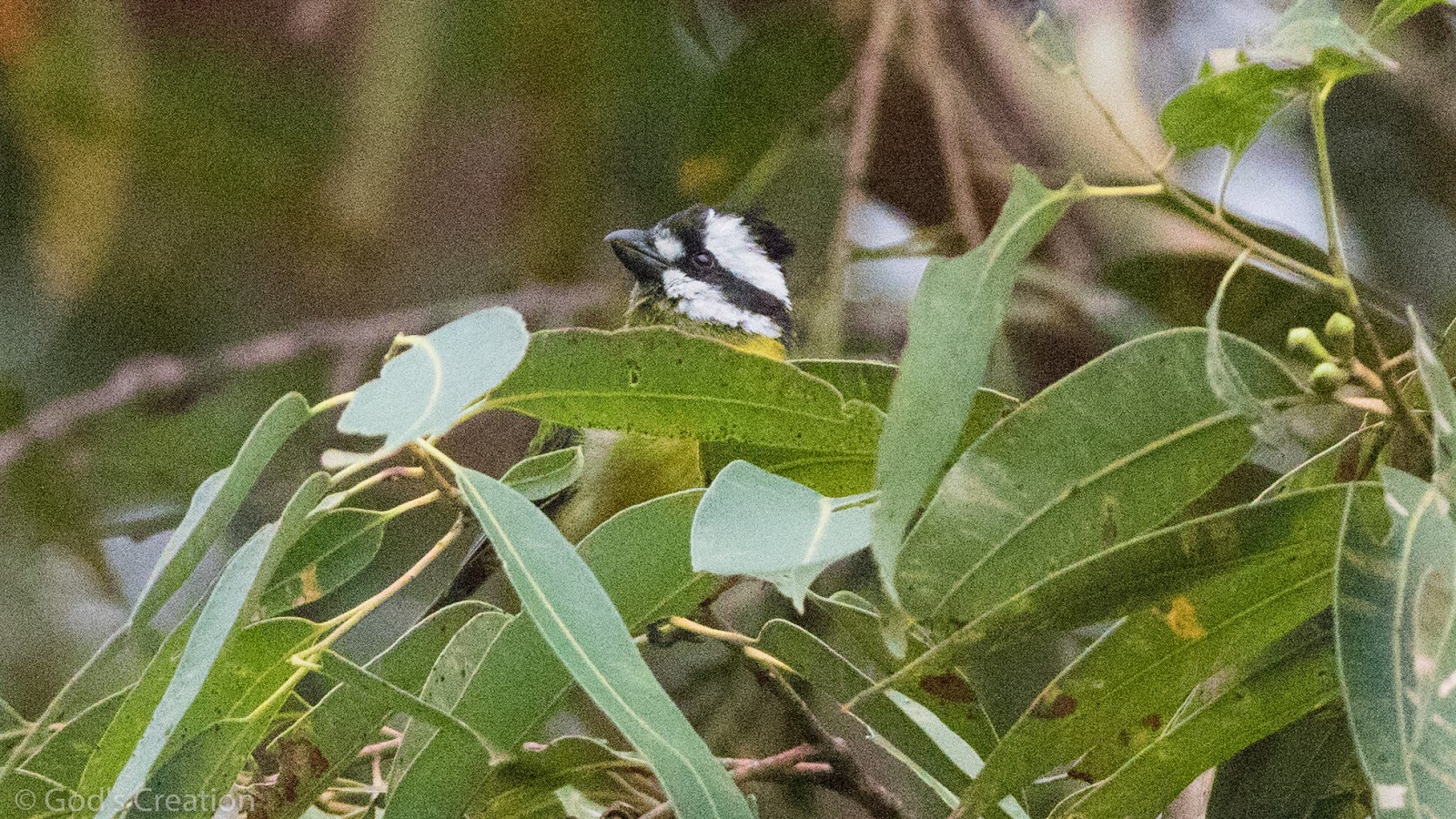
Twitch of the breakfast was a Crested Shrike-tit. A pair hung around for the best part of an hour allowing many photo-opportunities but none of them in decent light.


After breakfast and breaking camp, we headed a few kilometres to the east to Clinton Rocks and the reason for coming to this neck of the woods. Wandering Tattler.


Thursday, 3 March 2016

Wandering Dutchman meets a crake-quake

After the You Yangs it was off to the Western Treatment Plant at Werribee for lunch and a good dose of birds. We stayed until dark getting about 60 species of birds but special highlights included ...
  • The sheer number of duck species and ducks numbering into the thousands. Pacific Black, Grey Teal, Chestnut Teal, Australian Shelduck, Australian Shoveler, Pink-eared Duck, Hardhead, Australian Wood Duck, Freckled Duck, Blue-billed Duck and Musk Duck.
  • A Peregrine Falcon seeing off a Swamp Harrier.


Not the best photo ever taken of a Peregrine Falcon but somehow,
for these two pictures, the camera was set to shutter priority at 1/400 sec.
Way too slow for the action.

  • A fabulous flyby close-up of an immature and moulting Brown Falcon.


  • The setting sun throwing beautiful colours on the ponds and paddocks.

Towards sunset, we drove to the Crake Pond, an area where three species of crake had been seen over the last few weeks. We stationed ourselves on the sunset side to the pond with excellent views of the reeds about 30 metres or so away. We spotted a Baillon's Crake [lifetick x 2]. After a little while, we decided to drive around to the other side of the reeds and see what was going on there. Around we went. We parked by the reeds which were much closer than the other side, about 2 metres away! But to the east [the reeds were to the west into the setting sun] was a pond with a heap of birds on it. Swans, White- and Straw-necked Ibis, Sharp-tailed Sandpipers, Curlew Sandpipers, Red-necked Stints, Common Greenshank [identified by Robert as we approached from their calls -- a common species in The Netherlands] and Marsh Sandpiper, a small version the Common Greenshank with a needle thin beak.

Marsh Sandpiper and Common Greenshank
So we "oo-ed" and "aah-ed" over the birds and open and closed the car door getting the scopes and the bird guides out and generally forgetting about the crakes behind us on the other side of the road. Once finished, we turned around and had a look at the reeds and there was, not one, not two but three species of crake, unconcernedly going about their business within five metres of the car and where we were standing. Australian Spotted Crake, Spotless Crake and Baillon's Crake. Just amazing. Three life ticks for Robert and one for myself. What a day.

Baillon's Crake
Australian Spotted Crake

The Spotless Crake was just a bit too quick and dark for our cameras.

So as darkness enveloped us we set off for Drouin and home having done about 900 kms in the first two days of Robert's stay!